

Camera health monitoring
Camera health monitoring is knowing, as it happens, when a camera can no longer see: covered, moved, defocused, frozen or offline. A camera that has gone blind is quiet, which is why it is usually found weeks later, when the footage is needed and is not there. Camzify raises tampering the moment it is confirmed, shows offline cameras and sites as such, and checks every camera's view as an item on the patrol round.
- Tampering in five modes, raised live
- Offline shown as offline, not as a stale frame
- Camera view checked on every round
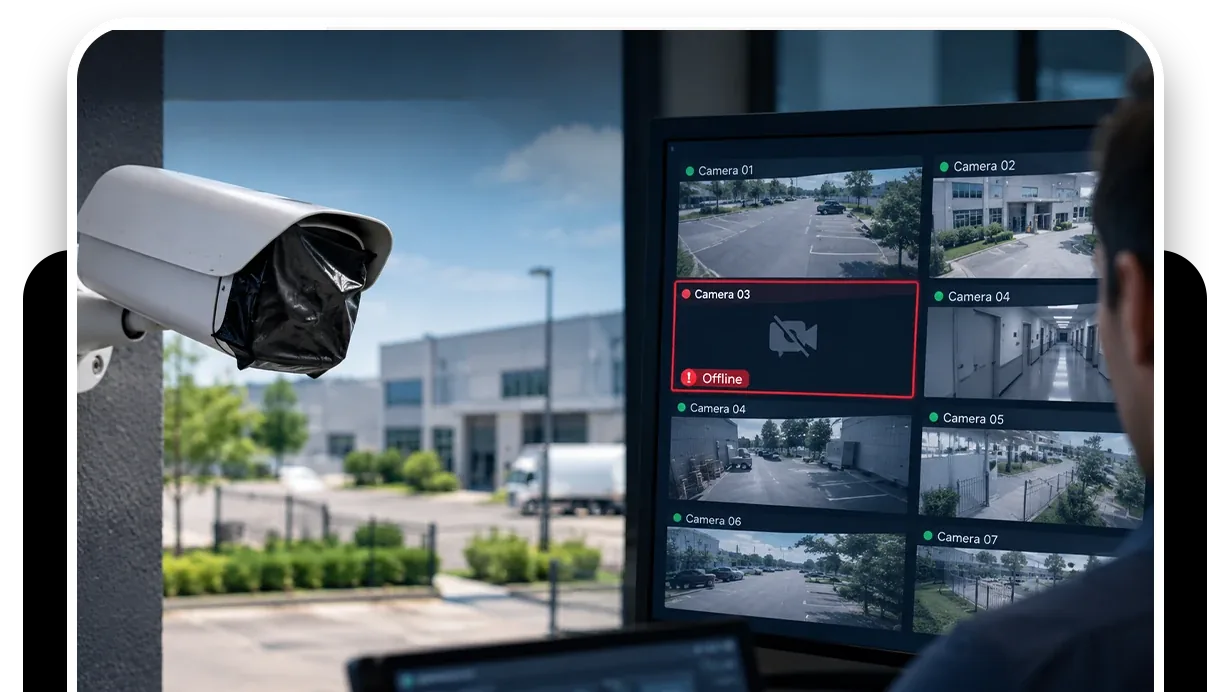
A blind camera is a quiet camera
Cameras fail slowly and silently. A lens fogs, a bracket drifts, a spider builds across the housing, a branch grows into the view, a feed freezes on a frame from Tuesday. Nothing alarms, because nothing is designed to. The failure is discovered when the footage is needed and the file shows a grey blur or a wall.
Deliberate tampering is faster and worse. A camera covered or turned on the way in is the first move in most intrusions that are planned, and the system it feeds carries on as if the view were fine.
- Warehouse — Sector 45/5 cameras online
- HQ Campus4/4 cameras online
- Retail — Downtown3/4 cameras online
- Distribution — North2/2 cameras online
- Each site runs its own sequences, schedule and guard roster on one account.
Tampering raised live, view checked on the round
Camera tampering detection watches each feed for five conditions, defocus, lens coverage, sudden scene change, abnormal brightness shift and frozen frames, and raises an alert the moment one is confirmed, because every other detection on that camera is blind until it is fixed. It runs on signal analysis rather than a neural network, so it costs no GPU. Cameras and sites that go offline are shown as such on the live wall and the dashboard, never as a stale picture.
The slow failures are caught by the patrol round: every stop can carry "camera view unobstructed" as an item, judged from the frame, so a drifted bracket or a web across the housing fails a check with a picture of it. Alerts for tampering and offline conditions route on their own category, so they reach whoever maintains the cameras.
Camera tampering detection
Defocus, coverage, scene change, brightness shift and frozen frames, raised as they happen.
DetectionMotion detection
Pixel-change detection, useful as a liveness signal on a feed that should never be static.
DetectionZone intrusion detection
The detection that goes blind first when a camera is covered. Worth protecting.
DetectionLine intrusion detection
The same. A tripwire on a camera that cannot see is not a tripwire.
- Camera view unobstructedNot compliant
- Image in focusCompliant
- Scene matches referenceCompliant
- Feed updatingCompliant
A failed item is resolved as Fixed or Pending before the round can close.
What a camera-health round checks
A camera-health round is every camera on the site, and the checklist is about the camera rather than the scene: view unobstructed, image in focus, scene as expected, feed updating. Run daily, it produces a report that every camera on the site could see at that time, which is the answer to the question an investigator asks first.
For an estate, every site's round reports into one place, and the multi-site console shows which sites have cameras down before anyone drives out.
A check found Not Compliant captures a snapshot and messages the guard designated for that camera; on a manual round the operator chooses to send it, on an automated round it goes on its own. The item stays Pending until it is marked Fixed, which captures the after frame, and the report shows both.
What it will not do
It will not fix the camera or tell you why it failed; it tells you that it did, and shows the frame. It will not diagnose a network outage beyond showing the camera or site offline. It will not detect a camera that was never pointed at the right thing; that is a checklist item for the person who installed it.
We do not publish figures for how quickly tampering is raised or how many blind cameras rounds find. The trust page sets out the policy.
Industries where this applies
Frequently asked questions
Ready to patrol your site 24/7?
Book a 15-minute demo and see a live patrol run on your own cameras.