

Loading dock security monitoring
Loading dock monitoring is the continuous verification of dock doors, staging areas and vehicle bays: doors closed when not in use, vehicles present only in their window, and staging areas clear. A dock combines stock, vehicle access and a door that opens forty times a day, which makes it the most common route for goods to leave a building. Camzify checks it on a round against the delivery schedule and tracks what arrives at the bay between rounds.
- Door status checked against the schedule
- Vehicles tracked at the bay, not plates
- Staging areas clear on the round
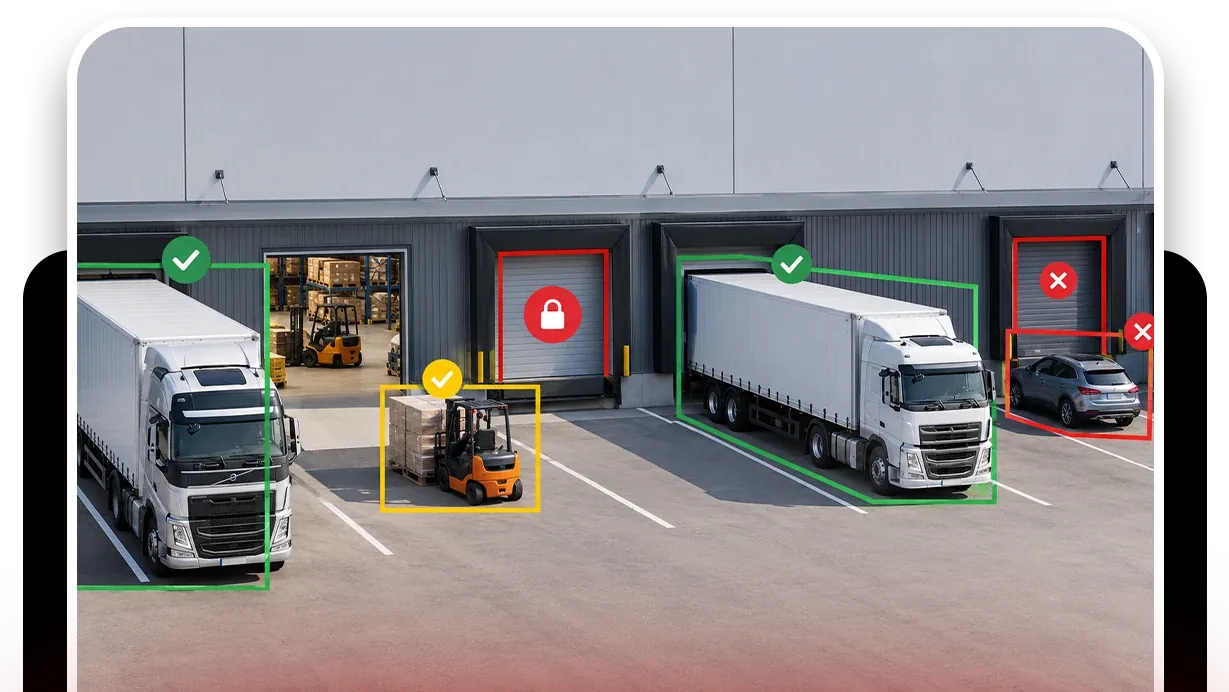
The door that is open forty times a day
A dock door left up overnight is an open wall. A vehicle at the bay outside the delivery window is either a mistake or a theft, and nobody on site can tell which from the office. Guards checking several docks on foot walk past a closed door and cannot see the one that was opened after they left.
The dock cameras see all of it, in the middle of a stream of legitimate deliveries, forklifts and staff that makes motion-based alarms useless and manual review impractical.
- Frequency
- Every 2 hours
- Active hours
- 19:00 – 07:00
Checked against the window, watched between checks
A patrol round visits each bay camera on a schedule and answers the list: door down, staging area clear, no vehicle at the bay outside the window, no one in the yard. Each answer is recorded with the frame. On an automated round the AI can watch the scene for a short period, which is how a forklift passing through and a person loading a van are told apart.
Between rounds, zone intrusion across the opening, with a notification window set to the hours outside deliveries, fires on a tracked person or vehicle passing through a door that should be down. Illegal parking detection covers a vehicle stopped at the bay or in the yard longer than it should be, and wrong-way vehicle detection a vehicle moving against the lane.
Zone intrusion detection
The door opening and the staging area as zones, with the delivery window as their hours.
DetectionIllegal parking detection
A vehicle stopped at the bay or in the yard beyond the time allowed.
DetectionWrong-way vehicle detection
A vehicle moving against the defined direction of the dock lane.
DetectionPPE violation detection
High-visibility clothing on the dock where it is mandatory. A safety check on the same cameras; see PPE compliance monitoring.
- Dock door downNot compliant
- No vehicle at the bayCompliant
- Staging area clearCompliant
- Yard gate closedPending
A failed item is resolved as Fixed or Pending before the round can close.
What a dock round checks
A dock sequence is one stop per bay plus the yard and the gate, and its checklist is the state each should be in at that hour. During the delivery window the items are light; after it, every door should be down, every bay empty, every staging area clear. The after-hours sequence is usually the one that earns its keep.
The report per round shows each bay with its frame, and a door found up shows the before and after frames once it has been marked Fixed. The reports page shows what one looks like. If the dock is also a hard-hat area, PPE compliance monitoring runs on the same cameras.
A check found Not Compliant captures a snapshot and messages the guard designated for that camera; on a manual round the operator chooses to send it, on an automated round it goes on its own. The item stays Pending until it is marked Fixed, which captures the after frame, and the report shows both.
What it will not do
It will not read plates, so it cannot tell a scheduled carrier from an unscheduled one by registration; it can tell that a vehicle is at the bay outside the window. It will not count pallets or verify a manifest. It will not close the door; it tells the guard designated for that camera and keeps the frame.
We do not publish detection rates or how much shrinkage dock rounds prevent. The trust page sets out why.
Industries where this applies
Frequently asked questions
Ready to patrol your site 24/7?
Book a 15-minute demo and see a live patrol run on your own cameras.