

Skip to content
Camzify
Role-Based, Site-Scoped Access

Security system user management

User management in Camzify supports sub-users with permission groups — a per-module View, Edit, Delete matrix. Site-level access control limits which locations a user can see. AI feature instance grants let a parent account allocate detection capacity to child accounts.
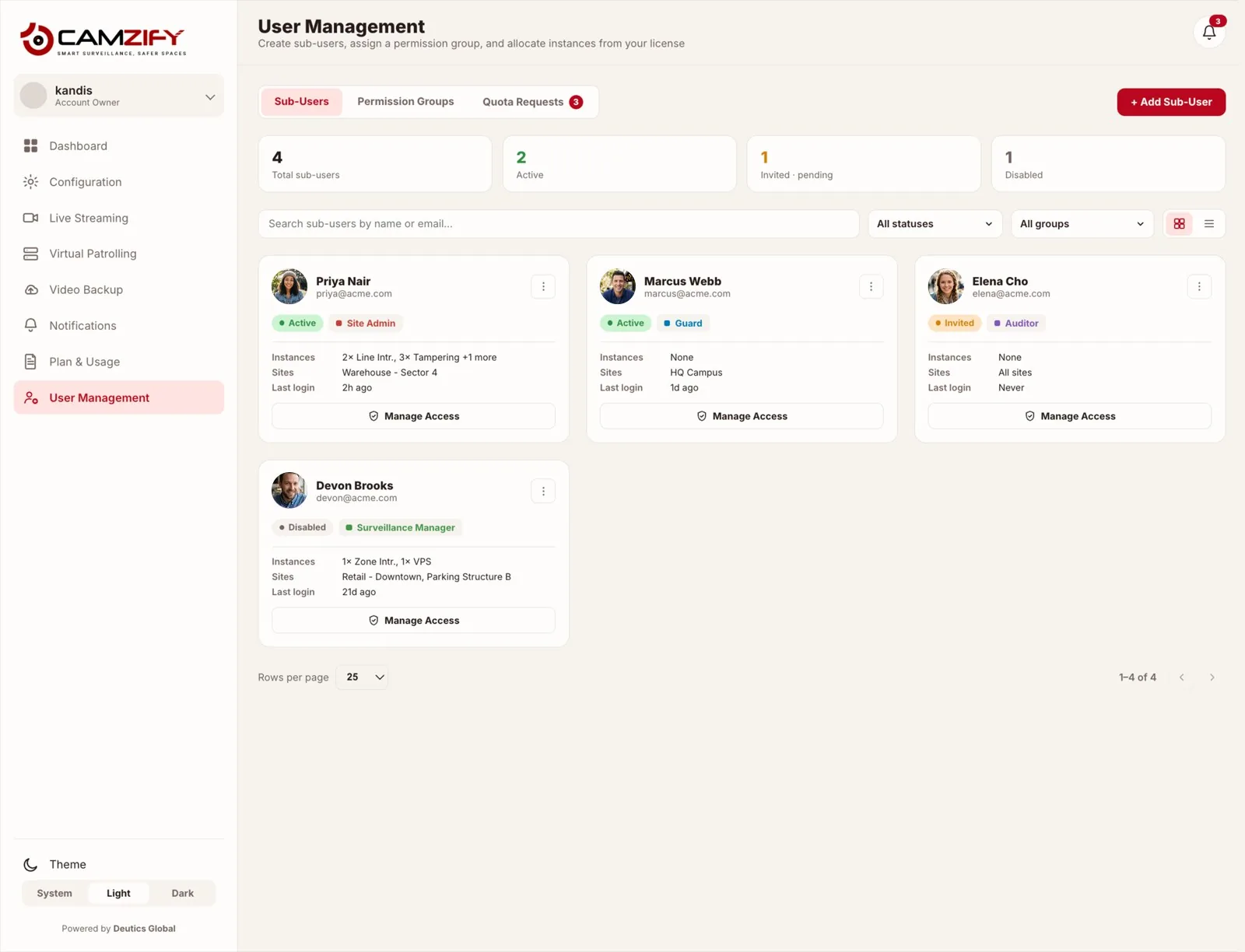
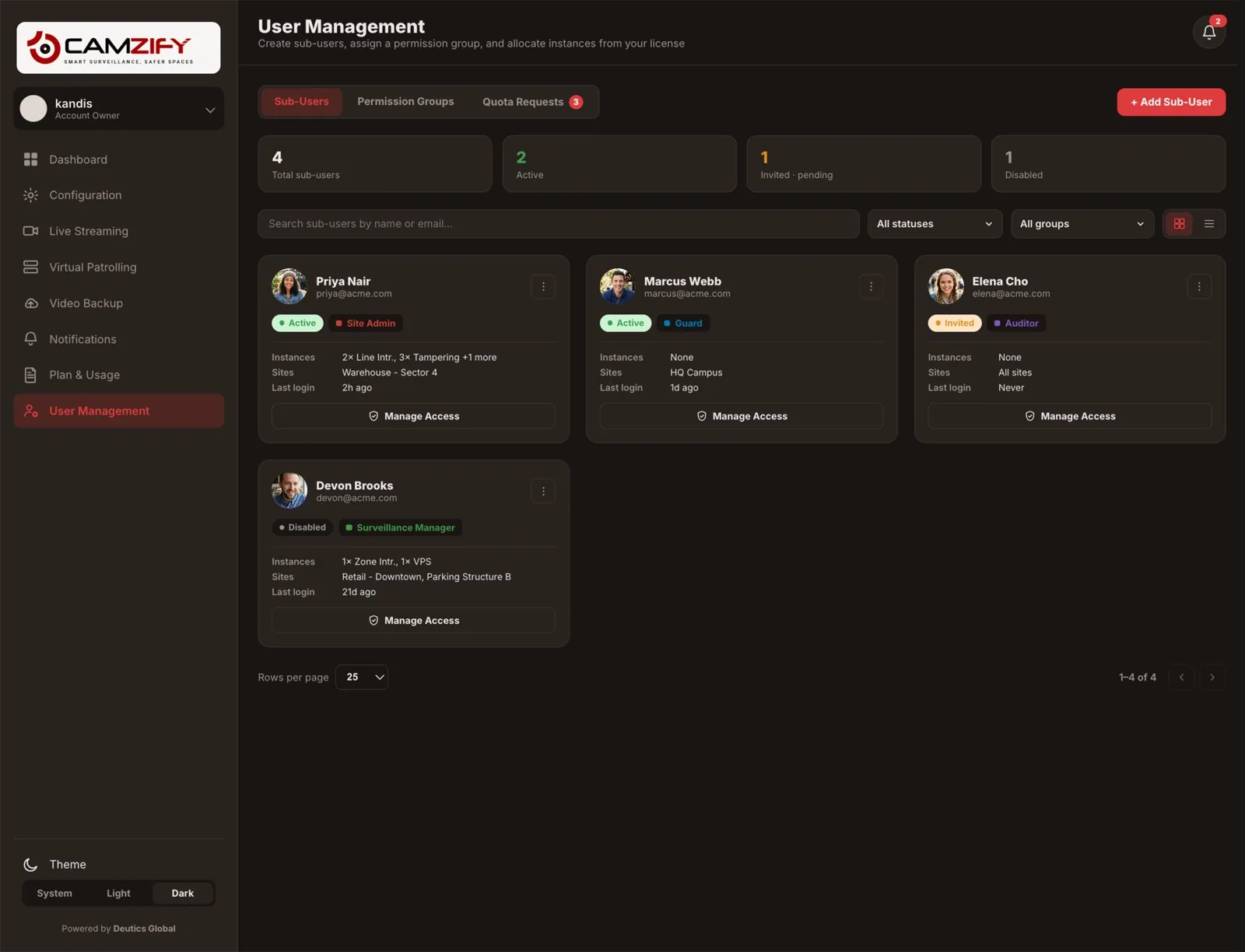
User management · Camzify console
A laptop showing the Camzify User Management screen with the Create Permission Group modal open, including page-access toggles and a View/Create/Edit/Delete instance permissions matrix
User Management · Sub-Users
4 permission groups configured
4
Total Sub-Users
2
Active
1
Invited
1
Disabled
Sub-Users
PN
Priya NairActive
priya@acme.com · Site Admin
Warehouse - Sector 4Instances: 2× Line Intr., 3× Tampering +1 more · Last login 2h ago
MW
Marcus WebbActive
marcus@acme.com · Guard
HQ CampusInstances: None · Last login 1d ago
EC
Elena ChoInvited
elena@acme.com · Auditor
All sitesInstances: None · Last login Never
DB
Devon BrooksDisabled
devon@acme.com · Surveillance Manager
Retail - Downtown, Parking Structure BInstances: 1× Zone Intr., 1× VPS · Last login 21d ago
In practice

How access is delegated

Role-based permission groups

Site Admin, Guard, Auditor, Surveillance Manager, or a custom group, each defines exactly what a sub-user can view, edit, or delete.

Per-user instance allocation

AI feature instances (Line Intrusion, Tampering, VPS, and more) can be granted to a sub-user straight from the parent account's license.

Multi-site scoping

Each sub-user is scoped to one site, several, or all sites, visibility never has to be all-or-nothing.

Invite / disable lifecycle

Sub-users move cleanly through Invited, Active, and Disabled states without losing their configured role or site scope.

Part Of Every Patrol

One account, many roles

This module integrates with virtual patrolling to provide a complete operations picture. Patrol results, detection alerts, and platform status all feed into the same console.

The detailed permission matrix, the exact View, Edit, and Delete grants each of the four built-in groups carries per module, lives on its own page. See Permission Groups for the full breakdown, or License & Instance Management for how AI detection capacity is licensed and allocated in the first place.

Permission Groups
Site AdminBroad access across an assigned site
GuardDay-to-day monitoring, limited edit rights
AuditorRead-focused access for review and compliance
Surveillance ManagerManages cameras and detection across sites
See the full permission matrix →
FAQ

Frequently asked questions

Build a permission group first, then add the user against it, assign their sites and cameras, and allocate license quota from what you hold. The walkthrough is at /guides/how-to-manage-sub-users-and-quotas.

Yes, on the same model as the parent account. A sub-user can create users beneath them, assign a permission group, and allocate sites, cameras, feature instances and backup storage out of their own unused quota, never more than they hold. Subscription end date and pricing stay parent-admin-only, so a delegated administrator can run their part of the account without touching commercial terms.

They see the limit and are offered a quota request form rather than a dead end. The request arrives in the parent account under User Management, where it can be approved, if there is enough unallocated quota to cover it, or declined. Nothing is granted automatically, so the parent account keeps control of what has been handed out.

Yes. Deactivating a user blocks sign-in while keeping their allocation and data reserved, so a contractor between shifts or a member of staff on leave can be restored later without rebuilding their access. Deleting is the separate, permanent action.

From that user's menu in User Management, either set a password directly or generate a strong random one. It does not require the user to start a reset from their own end, which matters for shift staff who need access restored while they are on site.

They typically return to the parent account's available pool once the sub-user is disabled, freeing that detection capacity to be reassigned elsewhere rather than sitting unused against an inactive account.

Not by default. Sub-user visibility is scoped by permission group, and seeing the account's user list is its own permission — a Guard or Auditor role typically won't see who else has been invited unless that access is explicitly granted.

Invited means the account has been created and a role, sites, and any instance allocation assigned, but the person hasn't accepted the invite and logged in yet — their status flips to Active on first login. An invite that's never accepted stays in that pending state until it's accepted or the invite is revoked.

Yes. Site access is assigned per sub-user and isn't limited to a single location — a role like Surveillance Manager, for example, can be scoped to several sites at once, such as a retail location and a parking structure.

Each AI feature instance granted to a sub-user is drawn from the parent account's licensed capacity — allocating detection instances to a sub-user reduces what's available for the parent account or other sub-users until it's reassigned or freed up.

Ready to patrol your site 24/7?

Book a 15-minute demo and see a live patrol run on your own cameras.

This site is being updated

We are rebuilding pages as you read this, so an image, a link or a section may look unfinished for a while. The product itself is unaffected. If something important is broken, tell us at the contact page and we will fix it.