

Fire and smoke monitoring
Fire and smoke monitoring on security cameras is visual detection of flame and smoke in the camera view, raised as a critical alert with a clip, as an early-warning layer alongside the building's certified fire systems. In a large or open space a ceiling sensor waits for smoke to reach it; a camera sees it where it starts. Camzify runs the detection on the cameras already installed and adds fire exits and escape routes to the patrol checklist.
- Visual flame and smoke, any standard camera
- Critical alert with a clip and a confidence score
- Fire exits checked on every round
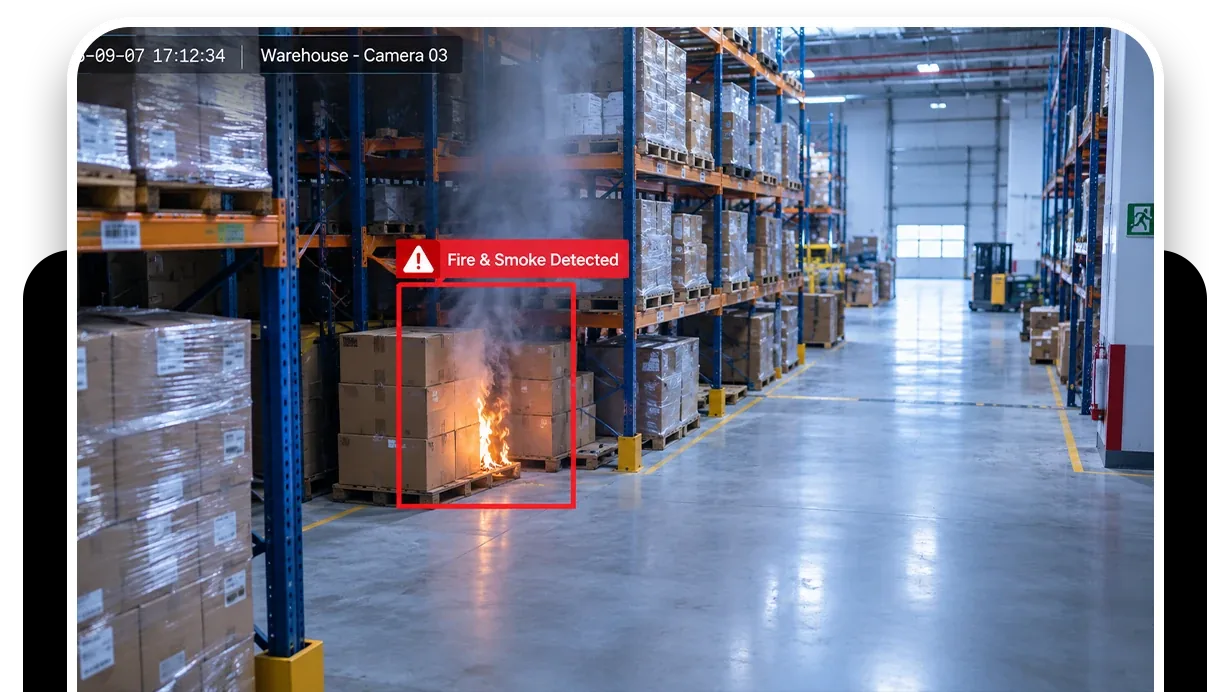
A sensor waits for the smoke to arrive
A smoke detector on a warehouse ceiling is doing its job and doing it late: it fires when enough particles have risen and drifted to reach it, which in a high, open or ventilated space can be minutes after the first flame. In an unmanned building overnight, those are the minutes that decide the outcome.
The same building has cameras on every aisle and every bay, watching the exact spot where a fire would start, and none of them is looking for one. Blocked fire exits are the other half of the problem: they are found on the annual inspection, not on the night they matter.
“Dock door left unsecured after delivery — confirm and lock.”
Unacknowledged alerts escalate to the backup contact after the configured window.
The camera watches for the fire. The round checks the way out.
Fire and smoke detection watches each camera's live feed for the visual signatures of flame and smoke and raises a critical alert with a clip and a confidence score when a match passes the threshold set for that camera. It runs on the standard cameras already in place; no thermal hardware is involved. Steam, dust and fog are the known confounders, and a person verifies from the clip before anyone calls anyone.
A patrol round covers the part no sensor does: at each stop it asks whether the fire exit is clear, whether anything is stacked against the electrical cabinet, whether smoke is visible, and records the answer with the frame. On an automated round the AI also raises a critical notification for a risk it sees that the checklist did not ask about. Abandoned object detection catches the pallet left in the escape route between rounds.
Fire and smoke detection
Visual flame and smoke on any standard camera, raised as a critical alert with a clip.
DetectionAbandoned object detection
A pallet, bag or box left in an escape route past a dwell time you set.
DetectionCamera tampering detection
A camera that cannot see the aisle cannot see the fire in it. Covered or turned, it raises an alert.
DetectionZone intrusion detection
Notifies on a person in a hazardous-materials store or plant room during the hours you set.
- Fire exit clearNot compliant
- No smoke visibleCompliant
- Nothing against electrical cabinetCompliant
- Extinguisher point unobstructedCompliant
A failed item is resolved as Fixed or Pending before the round can close.
What a fire-safety round checks
A fire-safety sequence is the cameras covering exits, escape routes, plant rooms and storage in walking order, and the checklist at each is the state a fire officer would want to find: exit clear, extinguisher point unobstructed, nothing against the switchgear, no smoke. Run it at closing and through the night, and the report per round is the record that the routes were clear at each time, with the frame to prove it.
The report is also what makes the inspection conversation short: a stack of passed rounds, each with frames, rather than a signature on a monthly sheet. Falls, exclusion zones and PPE on the same cameras are covered under workplace safety monitoring.
A check found Not Compliant captures a snapshot and messages the guard designated for that camera; on a manual round the operator chooses to send it, on an automated round it goes on its own. The item stays Pending until it is marked Fixed, which captures the after frame, and the report shows both.
What it will not do
It will not replace the fire alarm, the sprinklers or the inspection regime, and it is not certified as a life-safety system. It will not see a fire in a room without a camera, or behind a closed door, or through heavy steam. It will not call the fire service; it tells the person you designate, with a clip, and they decide.
We do not publish detection rates, lead times over sensors, or false-alarm figures, because they depend on your cameras and your building. The trust page sets out the policy.
Industries where this applies
Frequently asked questions
Ready to patrol your site 24/7?
Book a 15-minute demo and see a live patrol run on your own cameras.