

Guard tour verification
Guard tour verification is confirmation that a patrol round was completed, that every point was checked, and that what was found was recorded. Tag-based systems prove presence at a checkpoint and nothing about the checkpoint itself. Camzify runs a virtual round over the same points, judges the condition at each from the camera, keeps the frame, and files a report per round that can be set against the guard's own.
- The condition proven, not the tap
- A frame per checklist item
- A report per round, per client
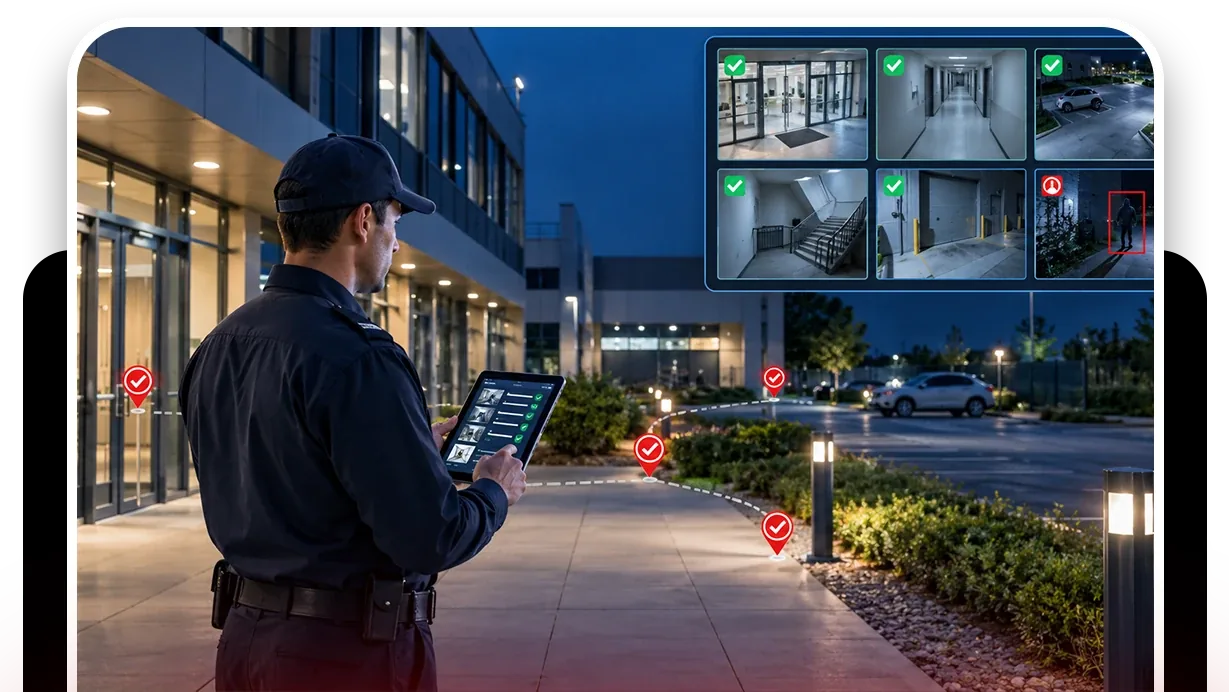
A tag proves the guard was there. Not what they saw.
A guard tour system asks the guard to scan an NFC tag or a QR code at each checkpoint, and the report says each was scanned at a time. It cannot say whether the door beside the tag was closed, whether the yard was clear, or whether the guard looked up at all. The tag can be tapped on the way past.
For a security agency that is a real problem: the client is paying for a round and receiving a list of taps. For the client it is worse, because the round that was not done properly is only discovered when something is found broken in the morning.


Guard message sent. Re-checked and closed with the second frame attached.
The same points, judged from the camera, with the frame kept
A patrol sequence is built over the same checkpoints as the physical round, one camera stop per point, with a checklist at each that asks what the guard is supposed to check: door closed, area clear, gate locked, fire exit unobstructed. The round judges each item from the frame and keeps that frame, so the report is a set of pictures with verdicts rather than a set of timestamps.
Run it on the guard's schedule and the two records line up by time. Run it between the guard's rounds and it covers the gaps. Either way the report is filed per round with a compliance percentage, and a client with a scoped login reads their own without anyone forwarding it.
Zone intrusion detection
Watches the areas between rounds, so a checkpoint is covered when nobody is at it.
DetectionCamera tampering detection
A verification camera that has been covered or turned is itself a finding.
DetectionAI attribute extraction
Describes the person seen at a checkpoint. Presence, not identity.
DetectionMulti-object tracking
The layer the detections run on, following each subject across frames.
- Plant room door closedCompliant
- Fire exit unobstructedCompliant
- Guard present at checkpointPending
- Corridor clearCompliant
A failed item is resolved as Fixed or Pending before the round can close.
What a verification round checks
The verification sequence mirrors the physical round point for point, and each checklist asks the question the guard was meant to answer there. It can also ask whether the guard attended, judged from the frame. The result is two records of the same round, one from the guard and one from the cameras, that either agree or do not.
For an agency the report is proof of service that the client can read per round. The security agencies page covers how the account is set up so each client sees only their own.
A check found Not Compliant captures a snapshot and messages the guard designated for that camera; on a manual round the operator chooses to send it, on an automated round it goes on its own. The item stays Pending until it is marked Fixed, which captures the after frame, and the report shows both.
What it will not do
It will not identify the guard; it can see that a person was at the checkpoint and describe them, not name them. It will not verify a point with no camera on it, so a round with blind checkpoints keeps them blind. And it will not replace the guard: the round proves the condition, and a person still attends what fails.
We do not publish figures on how often rounds are found to have been skipped, because it is not our number to publish. The trust page sets out the policy.
Industries where this applies
Frequently asked questions
Ready to patrol your site 24/7?
Book a 15-minute demo and see a live patrol run on your own cameras.