

Violence and weapons detection
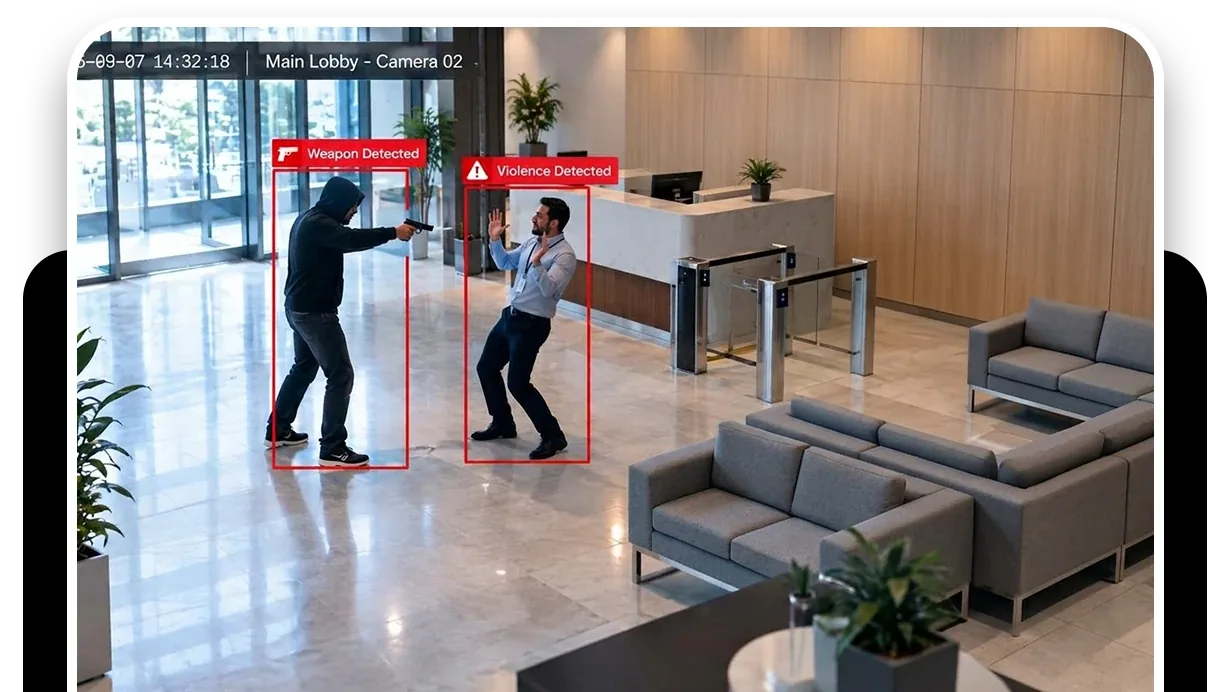
Violence and weapons detection on cameras is the visual recognition of a brandished weapon, or of a physical altercation between people, raised as a critical alert with a clip the moment it is confirmed. The point is that the response starts while the event is happening rather than after the footage is reviewed. Camzify runs both detections on the cameras already covering entrances, floors and corridors, and puts the clip in front of a person to verify.
- Visible weapons and altercations, raised live
- Critical severity with a clip to verify
- Not a scanner, not facial recognition
The footage is reviewed after the ambulance has left
An altercation on a shop floor or a school corridor lasts a minute, and the camera above it records the whole thing for someone to watch later. The guard at the front desk learns about it from a shout, or from a phone call, or from the report the next day. The recording changes what can be proven; it changes nothing about the minute.
A visible weapon is the same problem with a shorter clock. The camera sees it before anyone in the building does, and it says nothing.
“Dock door left unsecured after delivery — confirm and lock.”
Unacknowledged alerts escalate to the backup contact after the configured window.
Raised when it is confirmed, verified by a person
Weapons detection flags a visibly brandished firearm or edged weapon the moment it enters the frame and raises a critical alert with a clip and a confidence score. It is a visual model: it does not see through a bag or a coat, and it is not a scanner. Aggression and fight detection watches the movement between individually tracked people and fires on the sustained, aggressive pattern of an altercation rather than on a busy scene.
Both are usually enabled together, because one escalates into the other. Both default to critical severity, and both put a clip in front of a person, because the correct workflow is to verify in seconds and then escalate, not to escalate on the alert alone. Afterwards, AI suspect search finds the same person on other cameras by description, and cloud backup holds the footage within the retention set for that camera.
Weapons detection
A visibly brandished firearm or blade in frame, raised as critical with a clip. Not concealed weapons.
DetectionAggression and fight detection
Sustained aggressive movement between tracked people. A queue or a crowd does not match.
DetectionAI suspect search
Find the same person on other cameras afterwards, by description. Not facial recognition.
DetectionMulti-object tracking
The tracks the fight model evaluates motion between, and the weapon model attaches to.
- Entrance clear of obstructionCompliant
- No altercation in progressCompliant
- Guard present at deskCompliant
- Camera view unobstructedCompliant
A failed item is resolved as Fixed or Pending before the round can close.
Where the round fits
These detections are continuous and do not wait for a round. The round adds the record: at each stop, the entrance was clear, no altercation was in progress, the desk was staffed, the camera could see. Repeated through the day, it shows the site was in order at each time, which matters in the review that follows an incident.
On an automated round, the AI also raises a critical notification for a risk it sees at a stop that the checklist did not ask about.
A check found Not Compliant captures a snapshot and messages the guard designated for that camera; on a manual round the operator chooses to send it, on an automated round it goes on its own. The item stays Pending until it is marked Fixed, which captures the after frame, and the report shows both.
What it will not do
It will not detect a concealed weapon; it is not a metal detector or an X-ray. It will not identify anyone. It will not prevent the event; it shortens the time between the event and a person knowing, and the response is that person's. It will produce some alerts that a human, looking at the clip, will dismiss, and the workflow is built for that.
We do not publish detection or false-alert rates for these models. The trust page explains why, and it applies here more than anywhere.
Industries where this applies
Frequently asked questions
Ready to patrol your site 24/7?
Book a 15-minute demo and see a live patrol run on your own cameras.